

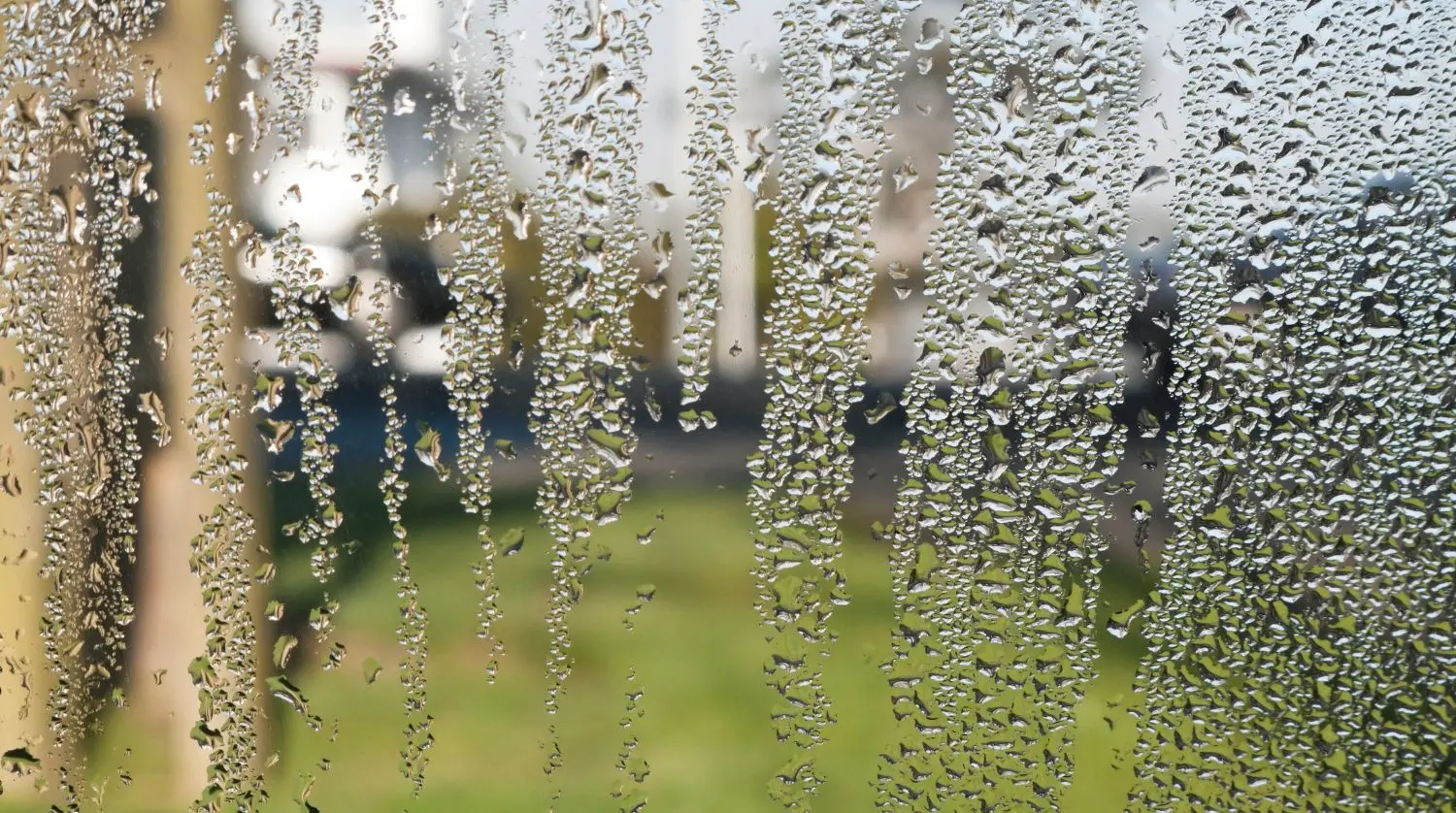
Why Is There Condensation on the Inside of My Windows?
Condensation on the inside of windows in Santa Barbara homes happens when warm, humid indoor air touches glass that is colder than the air’s dew point, the temperature where water vapor turns back into liquid. It is usually a humidity problem, not a window defect. Fog trapped between the panes is different: that points to a failed seal.
Bella View Windows & Doors has replaced windows and doors for homeowners across the Santa Barbara South Coast since 1982, from Goleta and Montecito to Carpinteria and the Santa Ynez Valley. As a Milgard Certified dealer holding CSLB License #1121282, our Santa Barbara window installers see every kind of window moisture, from a little morning fog on a bathroom window to water pooling on a sill after a winter storm. This guide explains what each one means and what to do about it, and our window and door replacement services page covers the products and installation options available when a window does need replacing.
Request a free in-home window consultation if you would like a Santa Barbara window replacement team to look at fogged, wet, or failing windows in person.
Is Condensation on the Inside of Windows a Problem?
A light film of condensation on the inside of windows on a cold morning is common and usually harmless if it clears within a few hours. Condensation becomes a problem when it drips onto the sill, returns every day, or stays wet long enough to stain wood, peel paint, or feed mold around the frame.
The U.S. Environmental Protection Agency treats visible condensation on windows, walls, or pipes as a sign that indoor humidity may be too high. EPA guidance says to dry the wet surface quickly and reduce the source of moisture, and to dry water-damaged materials within 24 to 48 hours to help prevent mold growth.
Watch for these signs that window condensation needs attention:
- Water running down the glass and collecting on the sill or in the window track.
- Black or gray spotting on caulk, wood sills, window returns, or the bottom of curtains.
- Paint bubbling or peeling on the wall directly below the window.
- A musty smell in a bedroom or bathroom that is closed up overnight.
- Wood sashes or sills that feel soft when pressed.
Why Do Santa Barbara Homes Get Window Condensation?
Santa Barbara homes get window condensation mostly on cool winter and spring nights, when glass temperature drops while indoor air holds moisture from cooking, showers, laundry, and sleeping. Coastal fog and the marine layer keep outdoor air damp, so opening the house to dry out works less well on gray days.
The South Coast does not get the deep freezes that cause heavy window frost in colder states, but window condensation does not need freezing weather. It only needs the glass to be colder than the dew point of the indoor air. A bedroom with two people sleeping and the door closed, a kitchen with a pot simmering, or a bathroom after a long shower can push indoor humidity high enough for water to form on cool glass.
Several local patterns make window condensation more likely in Santa Barbara, Goleta, Carpinteria, and Montecito homes:
- Rainy-season habits. During winter storms, windows stay shut for days and clothes often dry indoors, which adds a surprising amount of water vapor to the air.
- Marine layer mornings. Damp, cool mornings near the coast keep glass cold and limit how much moisture a home can shed by airing out.
- Older single-pane glass and aluminum frames. Many mid-century South Coast homes still have single-pane glass or non-thermally-broken aluminum frames, which run much colder than modern dual-pane units.
- Tighter homes after remodeling. New windows, doors, and weatherstripping cut drafts, and those drafts used to carry humid air outside.
- Window coverings pulled tight. Heavy drapes or cellular shades closed against the glass trap cold air at the window and keep warm room air from reaching it.
How Can You Tell Where the Condensation Is Forming?
Wipe the glass with a dry cloth from inside, then from outside. If the moisture comes off on the room side, it is interior condensation caused by indoor humidity. If it wipes off outside, it is exterior dew. If neither side clears the fog, the moisture is trapped between the panes and the glass seal has failed.
Each location means something different, and only one usually calls for new glass:
- Interior condensation (room side). This is a humidity and ventilation issue. Reducing moisture indoors is the first fix, and the window itself is often working normally.
- Exterior condensation (outside surface). Milgard describes exterior condensation as the same thing as dew on grass, and notes that it can be a sign the insulating glass is doing its job by keeping indoor heat from warming the outer pane. It generally burns off as the morning warms.
- Between the panes. Dual-pane glass, also called an insulating glass unit, is two panes sealed around the edge with a spacer and often filled with argon gas. Moisture inside that sealed space means the edge seal has broken and humid outdoor air is getting in.
What Does Fog Between the Panes Mean?
Fog, haze, or water droplets between the panes of a dual-pane window mean the edge seal on the insulating glass unit has failed. The moisture cannot be wiped away, and the insulating gas has likely escaped. The usual fix is replacing the glass unit or the sash, or replacing the whole window if the frame is also worn.
A failed seal often shows up first as a faint cloudy streak that comes and goes with the weather, then turns into permanent haze or mineral spotting on the inner glass surfaces. Some homeowners also notice that the view through the glass looks slightly distorted. Sun exposure, age, and repeated heating and cooling of the glass all put stress on the seal over time.
Before paying for repairs, check whether the window is still under its manufacturer warranty. Look for a label or etched code on the glass spacer, or on the frame, that identifies the manufacturer and production date. Warranty terms vary by brand, product line, purchase date, and ownership history, so the manufacturer’s published warranty for that specific product governs. For example, Milgard’s Full Lifetime Warranty for eligible products installed in the United States after January 1, 2020, excludes ordinary condensation on the glass or frame surface except to the extent it is caused by a failure of the product, and it spells out how coverage applies to the original owner and to later owners of the home.
Our Santa Barbara window replacement team can help you read the labels on existing windows and decide whether a glass replacement, a sash replacement, or a full window replacement makes more sense for the opening.
How Do You Stop Condensation on the Inside of Windows?
To stop condensation on the inside of windows, lower indoor humidity and move more air across the glass. Run kitchen and bathroom exhaust fans, open windows briefly each day when weather allows, keep shades a few inches off the glass, and use a dehumidifier in damp rooms. The EPA recommends keeping indoor relative humidity between 30 and 50 percent.
Relative humidity is the amount of water vapor in the air compared with the most the air can hold at that temperature. A small digital hygrometer from a hardware store shows the reading so you can tell whether changes are working. EPA guidance says to keep indoor humidity below 60 percent, and ideally between 30 and 50 percent.
Practical steps that reduce window condensation in South Coast homes:
- Run the bathroom fan during every shower and for 20 to 30 minutes afterward.
- Use the range hood when cooking, especially when boiling water or simmering soups.
- Confirm the clothes dryer vents to the outdoors and the vent hose is not crushed or disconnected.
- Avoid drying laundry on racks indoors during long rainy stretches, or run a dehumidifier in that room.
- Open windows for a few minutes each day on dry afternoons to exchange humid indoor air for drier outdoor air.
- Raise blinds and shades a couple of inches above the sill, a step Milgard’s care guidance recommends, so room air can reach the glass.
- Move large groups of houseplants, aquariums, and humidifiers away from windows, or turn humidifiers down.
- Keep interior doors open at night when practical so bedrooms do not hold all of the moisture from sleeping occupants.
- Wipe sills and tracks dry in the morning so water does not sit against wood, caulk, or drywall.
Do Single-Pane and Aluminum Windows Get More Condensation?
Yes. Single-pane glass and older aluminum frames without a thermal break run much colder than dual-pane low-E glass in vinyl or fiberglass frames, so they reach the dew point sooner. Water often appears first along the metal frame and the bottom edge of the glass, where surfaces are coldest.
Aluminum conducts heat quickly, so an aluminum frame with no thermal break, which is an insulating strip separating the inner and outer metal, stays close to the outdoor temperature. Single-pane glass does the same. On a cool night, both can collect water even at moderate indoor humidity.
Several features of modern replacement windows help keep the interior glass surface warmer:
- Dual-pane insulating glass, which places a sealed air or gas space between the room and the outdoors.
- Low-E coatings, which are microscopically thin metal oxide layers on the glass that reflect heat back toward its source.
- Warm-edge spacers, which reduce the cold strip along the edge of the glass where condensation usually starts.
- Vinyl, fiberglass, or thermally broken frames, which conduct less heat than plain aluminum.
Salt air adds another wrinkle near the beach. Coastal moisture and salt can corrode older aluminum frames and hardware, and our guide to the best windows for coastal homes in Santa Barbara explains how frame materials and hardware choices hold up in that environment.
Will New Windows Stop Condensation on the Inside?
New windows cannot guarantee an end to condensation on the inside of windows, because indoor humidity still drives it. Dual-pane low-E windows keep the interior glass warmer, which narrows the conditions where condensation forms. The NFRC label’s optional Condensation Resistance rating, scored from 1 to 100, lets you compare products.
The National Fenestration Rating Council (NFRC) is the independent nonprofit that certifies window, door, and skylight performance ratings. On the Condensation Resistance scale, a higher number means the product resists interior condensation better. The rating is a comparison tool measured under fixed test conditions, so it cannot predict whether condensation will form in a particular home, and not every manufacturer reports it.
The other numbers on the NFRC label matter for comfort and code compliance too:
- U-factor measures how quickly a window lets heat escape. A lower U-factor means better insulation and usually a warmer interior glass surface.
- Solar Heat Gain Coefficient (SHGC) measures how much of the sun’s heat passes through the glass. A lower SHGC blocks more solar heat.
- California Energy Code, Title 24 Part 6, sets the energy requirements replacement windows must meet in California, and the NFRC label is how compliance is documented. The City of Santa Barbara, the City of Goleta, the City of Carpinteria, and the County of Santa Barbara each handle building permits within their own jurisdictions, so confirm permit requirements with the agency that serves your address.
One more point catches some homeowners by surprise. Because new windows seal tighter than old ones, a home can feel more humid after replacement, and condensation may show up on the new glass during the first damp season. That usually means the house now needs more deliberate ventilation, not that the new windows are failing.
When Is Water on a Window a Leak Instead of Condensation?
Water on a window is likely a leak, not condensation, when it appears during or right after rain, collects at one corner, runs from the top of the frame, or stains the wall and floor below the window. Condensation forms evenly on cold glass, while leaks follow gaps in caulking, flashing, or the frame.
Winter storms on the South Coast often bring wind-driven rain that finds weak spots around older windows. Clues that point to a leak include:
- Water appearing on dry, mild days only when it is raining, not on cold, clear mornings.
- Drips coming from the head of the window or from the joint between frame and wall.
- Swelling, staining, or soft drywall below one corner of the window.
- Cracked or missing exterior caulk, gaps in stucco around the frame, or clogged weep holes in the sill.
Leaks change how a window should be replaced. A retrofit installation sets the new window inside the existing frame and leaves the surrounding stucco or siding intact. A full-frame installation removes the old frame down to the rough opening, the framed hole in the wall, so the opening can be inspected, repaired, and reflashed. Flashing is the waterproof membrane that directs water away from the window. When water damage or failed flashing is suspected, full-frame replacement allows the hidden layers to be fixed, and Bella View Windows & Doors also handles stucco and drywall finishing after installation.
What Should Owners of Pre-1978 Homes Know Before Replacing Windows?
Owners of Santa Barbara homes built before 1978 should know that the federal EPA Renovation, Repair and Painting (RRP) rule applies to window replacement, because older paint may contain lead. Firms doing the work must be EPA-certified and follow lead-safe work practices unless testing shows the affected components are lead-free.
Many houses in Santa Barbara’s older neighborhoods, Montecito, and downtown Carpinteria were built before 1978. Removing old wood sashes and frames can disturb painted surfaces, so lead-safe practices such as containment, dust control, and cleaning verification are part of the job. Homes inside a historic district or listed as historic resources may also need design review before window changes, and our article on how the Historic Landmarks Commission reviews window changes explains that process for City of Santa Barbara properties.
How Do Our Santa Barbara Window Installers Handle Condensation and Fogged Glass Problems?
Our Santa Barbara window installers start by finding out whether the moisture is interior condensation, a failed glass seal, or a leak, because each one has a different fix. From there, the process moves through measurement, product selection, permits, ordering, installation, testing, and a final walkthrough with the homeowner.
- Free in-home consultation and measurement. During the visit, our Santa Barbara window replacement team looks at the affected windows, checks for leaks and seal failure, talks through options, and provides pricing on the spot. Every opening is measured using a dual-check process.
- Product and glass selection. Options include vinyl, fiberglass, aluminum, and wood clad windows from manufacturers including Milgard, Anlin, and Windsor, with glass packages chosen for the room, sun exposure, and coastal conditions.
- Permits and reviews. Permits are pulled with the correct city or county, and any HOA architectural committee or historic review is planned for before ordering.
- Ordering and lead time. Materials typically arrive in four to six weeks.
- Installation day. In-house installers re-measure each opening before removing the old window, then install and seal the new unit. Most installations are finished in one day.
- Testing, cleanup, and walkthrough. Every unit is tested for smooth operation, the site is cleaned, and the homeowner gets a walkthrough of the new windows and how to care for them.
- Warranty follow-up. If a question comes up later, our Goleta and Santa Barbara window replacement crew helps connect the homeowner with the manufacturer’s warranty process.
Why Choose Bella View Windows & Doors for Your Window Replacement Project?
Bella View Windows & Doors has served Santa Barbara, Goleta, Montecito, Carpinteria, and Santa Ynez since 1982. As a Milgard Certified dealer, Bella View holds CSLB License #1121282, uses in-house installers, and treats every opening as if it will face salt air and winter storms for decades.
The goal on every South Coast project is the right window for the house and the budget, not the most expensive one. That might mean a single replacement glass unit for a fogged picture window, a full-frame replacement where a storm leak has damaged the opening, or a whole-house project with patio doors and moving glass walls. Our Santa Barbara replacement window team also handles retrofit and full-frame installation, insurance repair and restoration for fire, wind, and water damage, and materials-only sales.
Contact Our Santa Barbara Window Installers
If condensation keeps returning, fog has appeared between the panes, or water is showing up at a sill during rain, a Santa Barbara window installer from Bella View Windows & Doors can take a look and explain the options. Schedule your free in-home window consultation, or visit the Bella View Windows & Doors showroom at 3010 State Street, Santa Barbara, CA 93111, Monday through Friday from 8am to 4:30pm. CSLB License #1121282.
This article is for general information only. Building codes, energy requirements, permit rules, rebates, and pricing change over time and vary by property. Confirm current requirements with your city or county before starting a project. Manufacturer warranty terms govern all warranty coverage.